Thanks for all the emailed messages of condolences.
Its been a pretty rough 10 months and the last month or so was the hardest.
We are picking up our lives gradually so I guess this means we are officially back online.
Madeleine
Tuesday, 12 February 2008


Friday, 11 January 2008
Offline for a while
Matt's mother lost her battle with cancer on Wednesday so we will be offline for a while.
Madeleine
Madeleine
Friday, 4 January 2008
More on Faith and Reason
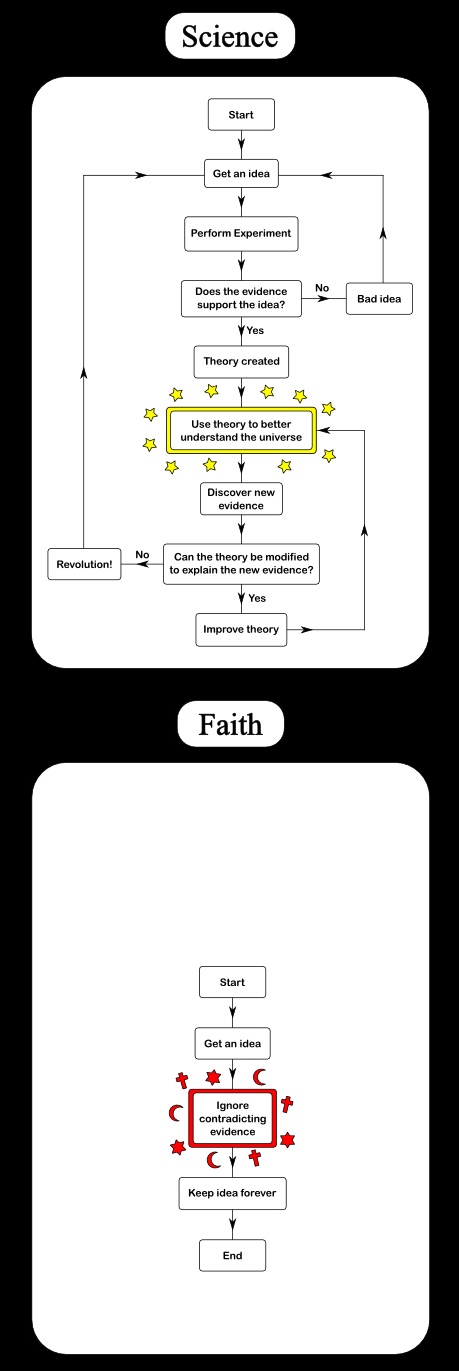
A correspondent of mine sent me a copy of this faith and science flow chart and asked me to comment on it. My thoughts are as follows.
1. The flow chart on faith appears to be a caricature. According to the chart faith is a three fold process, (a) one just comes up with an idea (out of nowhere it seems) (b) one ignores all the contrary evidence and (c) one continues to believe it. I don’t know who has ever held this model of religious epistemology certainly no one is cited as a representative. Whats noteworthy is that it differs from the model I have found in the writings of Christian Philosophers like Alvin Plantinga or Bill Craig or Roy Clouser. In these peoples writing the process faith involves some thing like the following: (a’) one finds the central message of Christianity to be self evident (to use Clouser’s terminology) (b’) one takes seriously evidence against Christianity and offers refutations of such arguments Finally (c’) one uses Christian beliefs as premises by which one develops a coherent perspective of the world that answers to various philosophical ethical existential questions on the basis of this message.
Now it’s simply false on this model to suggest that faith is an idea a person simply “gets” and then believes ignoring all contrary evidence. In fact several ideas a person “gets” will not be accepted on faith according to this model. Any ideas one does not find self evident and which one has no reason or arguments for believing, any ideas which are self evidentially absurd, any ideas there are good arguments against and any ideas which are incoherent or which do not provide coherent perspectives or answers to existential and philosophical problems.
Now it may be the case that Christianity fails on one or more of these criteria. However this needs to be argued. One cannot simply assume it and then define faith so as to assume this is true.
2. While Philosophy of Science is not my area the little I have read suggests the science flow chart is excessively simplistic. Two initial observations suggest themselves. The first is the issue of under-determination of theories by the empirical evidence. On the model in the above flow chart. One adopts any idea that is consistent with the evidence. However, one thing Philosophers of Science often point out is that the empirical evidence alone is frequently compatible with several mutually incompatible theories. What leads one to choose one of these theories over another are non empirical assumptions about what types of theories are an are preferable to others. The second issue is that the flow chart suggests that if a person discovers empirical evidence that is contrary to the theory it’s rejected. But this also is not how science actually operates. Scientists frequently stick to a theory is spite of evidence against it until a better or more comprehensive one emerges. Most major theories in science have trouble with some empirical data, and the problems the empirical data provide are often not resolved till many decades after the theory is adopted.
3. Finally I want to note a few things about the model of science that are relevant to the faith science issue. Accepting the account in the chart for the sake of argument three points suggest themselves. First note that for the theory to work there needs to already believe certain things. One first needs to “get an idea” now one can only get an idea if they already have a set of beliefs about the world if one believed absolutely nothing then they would have no ideas at all. Second, one needs to test this idea against evidence, which means there will already be a body of information which the scientist already accepts as true by which ideas are tested. Finally one needs to use the theory to better understand the universe. This means that prior to the theory one already has a set of beliefs about reality and that generate various questions about it that one wants answers to and which create puzzles that need explaining. Hence prior to any scientific theorizing one needs to already to have quite a bit of beliefs about the reality. These beliefs are needed for the process in the flow chart to be followed hence they cannot be discovered or based on science in the first place. Moreover if the process in the chart is to be effective these beliefs will need to be beliefs which it’s rational for the scientist to accept. Hence the chart itself suggests that a large number of beliefs are rationally accepted, despite being unable to be scientifically proven, it also suggests that without these beliefs scientific theorizing will be impossible.
So my conclusion is this, first the account of faith is a caricature very different to the accounts actually proposed by Christian epistemologists. Second the account of science seems excessively simplistic and third even if the account of science is correct it shows that that science requires a body of beliefs which are rationally believed prior to and hence independently of the scientific method. This account then is quite compatible with the idea that there are some things one knows which cannot be proven scientifically. In fact this model requires such beliefs to get off the ground.
Finally let me make a final suggestion. Perhaps on some issues what divides believers and non believers is not that one follows science and the evidence and the other does not. But rather both start with different presuppositions by which the evidence is assesed. If this is true, a mere appeal to evidence or science will not resolve the dispute, one needs to have a deeper debate about the various presuppositions employed in assessing the evidence.
1. The flow chart on faith appears to be a caricature. According to the chart faith is a three fold process, (a) one just comes up with an idea (out of nowhere it seems) (b) one ignores all the contrary evidence and (c) one continues to believe it. I don’t know who has ever held this model of religious epistemology certainly no one is cited as a representative. Whats noteworthy is that it differs from the model I have found in the writings of Christian Philosophers like Alvin Plantinga or Bill Craig or Roy Clouser. In these peoples writing the process faith involves some thing like the following: (a’) one finds the central message of Christianity to be self evident (to use Clouser’s terminology) (b’) one takes seriously evidence against Christianity and offers refutations of such arguments Finally (c’) one uses Christian beliefs as premises by which one develops a coherent perspective of the world that answers to various philosophical ethical existential questions on the basis of this message.
Now it’s simply false on this model to suggest that faith is an idea a person simply “gets” and then believes ignoring all contrary evidence. In fact several ideas a person “gets” will not be accepted on faith according to this model. Any ideas one does not find self evident and which one has no reason or arguments for believing, any ideas which are self evidentially absurd, any ideas there are good arguments against and any ideas which are incoherent or which do not provide coherent perspectives or answers to existential and philosophical problems.
Now it may be the case that Christianity fails on one or more of these criteria. However this needs to be argued. One cannot simply assume it and then define faith so as to assume this is true.
2. While Philosophy of Science is not my area the little I have read suggests the science flow chart is excessively simplistic. Two initial observations suggest themselves. The first is the issue of under-determination of theories by the empirical evidence. On the model in the above flow chart. One adopts any idea that is consistent with the evidence. However, one thing Philosophers of Science often point out is that the empirical evidence alone is frequently compatible with several mutually incompatible theories. What leads one to choose one of these theories over another are non empirical assumptions about what types of theories are an are preferable to others. The second issue is that the flow chart suggests that if a person discovers empirical evidence that is contrary to the theory it’s rejected. But this also is not how science actually operates. Scientists frequently stick to a theory is spite of evidence against it until a better or more comprehensive one emerges. Most major theories in science have trouble with some empirical data, and the problems the empirical data provide are often not resolved till many decades after the theory is adopted.
3. Finally I want to note a few things about the model of science that are relevant to the faith science issue. Accepting the account in the chart for the sake of argument three points suggest themselves. First note that for the theory to work there needs to already believe certain things. One first needs to “get an idea” now one can only get an idea if they already have a set of beliefs about the world if one believed absolutely nothing then they would have no ideas at all. Second, one needs to test this idea against evidence, which means there will already be a body of information which the scientist already accepts as true by which ideas are tested. Finally one needs to use the theory to better understand the universe. This means that prior to the theory one already has a set of beliefs about reality and that generate various questions about it that one wants answers to and which create puzzles that need explaining. Hence prior to any scientific theorizing one needs to already to have quite a bit of beliefs about the reality. These beliefs are needed for the process in the flow chart to be followed hence they cannot be discovered or based on science in the first place. Moreover if the process in the chart is to be effective these beliefs will need to be beliefs which it’s rational for the scientist to accept. Hence the chart itself suggests that a large number of beliefs are rationally accepted, despite being unable to be scientifically proven, it also suggests that without these beliefs scientific theorizing will be impossible.
So my conclusion is this, first the account of faith is a caricature very different to the accounts actually proposed by Christian epistemologists. Second the account of science seems excessively simplistic and third even if the account of science is correct it shows that that science requires a body of beliefs which are rationally believed prior to and hence independently of the scientific method. This account then is quite compatible with the idea that there are some things one knows which cannot be proven scientifically. In fact this model requires such beliefs to get off the ground.
Finally let me make a final suggestion. Perhaps on some issues what divides believers and non believers is not that one follows science and the evidence and the other does not. But rather both start with different presuppositions by which the evidence is assesed. If this is true, a mere appeal to evidence or science will not resolve the dispute, one needs to have a deeper debate about the various presuppositions employed in assessing the evidence.
Friday, 14 December 2007
The Body Snatchers and the Problem of Pluralism
As I was driving around Auckland this morning talkback was rife with people discussing the recent body snatchers case; an estranged father, against the wishes of both the deceased and her next of kin stole his daughters body and buried it in a family plot. Of course I remember the furor over the previous case, and my thoughts now are as they were then.
What people seem unaware of, or at least have not articulated clearly, is that the controversy over this case is symptomatic of a deep problem with the popular liberal response to pluralism. Let me elaborate.
The problem of Pluralism is this: we have in New Zealand people who hold to and live in accord with various differing “comprehensive views” as Rawls called them. A comprehensive doctrine can be theistic like Islam or Christianity or it can be secular like certain forms of Naturalism; Marxism, Liberal rationalism, humanism etc. However such views function as religions in that they answer fundamental questions such as who are we, what is the nature of good, what is real, etc. Now the problem such plurality creates is this: How does one maintain peace and order in a society characterized by radical disagreement over these fundamental questions? Each group believes (and cannot but believe) that their view is true and the others mistaken. Failure to find a solution to this problem can be deadly people can and have killed each other over these questions.
In New Zealand the answer popularly given is “tolerance”. One should allow each person to believe and act in accord with whatever view they think is correct and no one should be compelled to adopt some form of enforced orthodoxy. However there is one immediate problem with this response. Sometimes believers in different comprehensive doctrines will interact with one another. Hence, there needs to be rules or norms governing the relationships between believers of different “comprehensive doctrines” and the obvious difficulty is that these different groups frequently disagree over precisely what the correct norms or rules which constitute our duties are.
This is the case in the body snatchers incident. One group of people come from a community in which individual autonomy is an important value (this btw reflects certain religious and philosophical beliefs articulated in the late middle ages). Under this understanding of the world, when a person dies the individual who died can, prior to death decide ( within reason) how their body is to disposed of. Moreover certain relatives, become next of kin and aquire the responsibility to carry the deceased’s wishes out. The problem is that people from other cultures have quite different understandings of the world. I am not an expert on Maori culture and so will not try and elaborate. But the idea seems to be that individual autonomy is subordinated to the wider family and certain traditions which this family are required to uphold. Hence the wider community decides where one is buried in accord with their traditions regardless of the individual in questions wishes. Moreover there are different understandings of what constitutes membership in the relevant group. One group tends to think that if one is not brought up within a culture or does not conciously adopt it they are not part of a group that embodies this culture. Another however believes that mere biological lineage determines ones membership in the culture.
In this case a person dies. According to group A the deceased is not part of group B and the right thing do do is X. According to group B, she is a member of group B and the right thing to do is Y. Y however is incompatible with X only one of the two options is possible. I maintain that there is no *culturally or religiously neutral* way of adjudicaticating this dispute. At the end of the day we must decide which view of the world is correct and side with the solution they propose.
This case shows up the popular liberal response to the problem. The popular response is to suggest that the no group can impose the norms they believe in upon another group. Instead, norms governing relationships between practioners and believers of different comprehensive doctrines should be governed of norms that all reasonable people can accept regardless of their religious or quasi religious beliefs. This idea is often described as “public reason” the notion that there is a set of premises which are accepted implicitly by all reasonable people from which public policy regarding what rights everyone has can and coercive laws enacted can be decided.
The problem, which this case shows, is that public reason is something of a myth. If one defines a "reasonable person" broadly there is simply does not exist a set of principles which is both accepted by all reasonable people and also sufficiently “thick” and comprehensive to provide a basis for answers to public policy questions. On the other hand if one defines "a reasonable person" narrowly to exclude radical disagreement the very concept of a reasonable person will depend on the truth of a particular comprehensive perspective for its plausibility. The debate over Gods existence is a good example. Alvin Plantinga has argued, correctly I think, that if God exists and created men in his image and then revealed himself to them, much of what Christians believe is probably rational. If however God does not exist, its probably a delusion. However, its impossible to come to an answer on the rationality of theism without presupposing a stance on the ontological question of its truth. In fact it's difficult to see how one can come to an understanding of what constitutes a *reasonable person* if without appealing to premises specific to some comprehensive doctrine about what exists and what sort of beings people are.
What people seem unaware of, or at least have not articulated clearly, is that the controversy over this case is symptomatic of a deep problem with the popular liberal response to pluralism. Let me elaborate.
The problem of Pluralism is this: we have in New Zealand people who hold to and live in accord with various differing “comprehensive views” as Rawls called them. A comprehensive doctrine can be theistic like Islam or Christianity or it can be secular like certain forms of Naturalism; Marxism, Liberal rationalism, humanism etc. However such views function as religions in that they answer fundamental questions such as who are we, what is the nature of good, what is real, etc. Now the problem such plurality creates is this: How does one maintain peace and order in a society characterized by radical disagreement over these fundamental questions? Each group believes (and cannot but believe) that their view is true and the others mistaken. Failure to find a solution to this problem can be deadly people can and have killed each other over these questions.
In New Zealand the answer popularly given is “tolerance”. One should allow each person to believe and act in accord with whatever view they think is correct and no one should be compelled to adopt some form of enforced orthodoxy. However there is one immediate problem with this response. Sometimes believers in different comprehensive doctrines will interact with one another. Hence, there needs to be rules or norms governing the relationships between believers of different “comprehensive doctrines” and the obvious difficulty is that these different groups frequently disagree over precisely what the correct norms or rules which constitute our duties are.
This is the case in the body snatchers incident. One group of people come from a community in which individual autonomy is an important value (this btw reflects certain religious and philosophical beliefs articulated in the late middle ages). Under this understanding of the world, when a person dies the individual who died can, prior to death decide ( within reason) how their body is to disposed of. Moreover certain relatives, become next of kin and aquire the responsibility to carry the deceased’s wishes out. The problem is that people from other cultures have quite different understandings of the world. I am not an expert on Maori culture and so will not try and elaborate. But the idea seems to be that individual autonomy is subordinated to the wider family and certain traditions which this family are required to uphold. Hence the wider community decides where one is buried in accord with their traditions regardless of the individual in questions wishes. Moreover there are different understandings of what constitutes membership in the relevant group. One group tends to think that if one is not brought up within a culture or does not conciously adopt it they are not part of a group that embodies this culture. Another however believes that mere biological lineage determines ones membership in the culture.
In this case a person dies. According to group A the deceased is not part of group B and the right thing do do is X. According to group B, she is a member of group B and the right thing to do is Y. Y however is incompatible with X only one of the two options is possible. I maintain that there is no *culturally or religiously neutral* way of adjudicaticating this dispute. At the end of the day we must decide which view of the world is correct and side with the solution they propose.
This case shows up the popular liberal response to the problem. The popular response is to suggest that the no group can impose the norms they believe in upon another group. Instead, norms governing relationships between practioners and believers of different comprehensive doctrines should be governed of norms that all reasonable people can accept regardless of their religious or quasi religious beliefs. This idea is often described as “public reason” the notion that there is a set of premises which are accepted implicitly by all reasonable people from which public policy regarding what rights everyone has can and coercive laws enacted can be decided.
The problem, which this case shows, is that public reason is something of a myth. If one defines a "reasonable person" broadly there is simply does not exist a set of principles which is both accepted by all reasonable people and also sufficiently “thick” and comprehensive to provide a basis for answers to public policy questions. On the other hand if one defines "a reasonable person" narrowly to exclude radical disagreement the very concept of a reasonable person will depend on the truth of a particular comprehensive perspective for its plausibility. The debate over Gods existence is a good example. Alvin Plantinga has argued, correctly I think, that if God exists and created men in his image and then revealed himself to them, much of what Christians believe is probably rational. If however God does not exist, its probably a delusion. However, its impossible to come to an answer on the rationality of theism without presupposing a stance on the ontological question of its truth. In fact it's difficult to see how one can come to an understanding of what constitutes a *reasonable person* if without appealing to premises specific to some comprehensive doctrine about what exists and what sort of beings people are.
That’s what’s seen in this case. We have two very different views of understanding the world. Each one if true entails that a certain course of action is mandated. If certain notions of individual autonomy then the body snatchers are wrong. If one does not they are not. The problem is according to a popular conception of liberal democracy the state has to be neutral with regard to differing faith or quasi faith positions. It should not privilege any group by writing its views into law and demanding that the others who don't accept the tradition live in accord with them. The state therefore can do nothing one way or the other. Interestingly that is precisely whats happend.
There is a solution to this. It’s an older view, and it’s far less palatable to many modern or post modern people, but it has the advantage of being correct. On this view the whole popular liberal idea of tolerance is a chimera. In his book Reason in the Balance Berkeley Law professor Philip Johnson argues that while liberal societies do not (and I would add should not) have established Churches they must always have a defacto “established religious philosophy.” By religious philosophy Johnson means “a way of about ultimate questions” and by saying its esthablished he means not that “dissenters are subject to legal punishment” but that “it provides the philosophical basis for law making and public education”. People who dissent will be tolerated within reasonable limits and what constitutes a "reasonable limit" will be determined by the esthablished religious philosophy.
In NZ the established religious philosophy ostensibly includes the proposition that killing non combatants in war is wrong hence Al Qaeda does not gain religious tolerance in NZ. In Saudi Arabia the established religious philosophy considers apostasy intolerable. In some "progressive" quarter’s today believing and teaching that homosexual conduct so violates the sensibilities of liberal orthodoxy that it cannot be tolerated. In each case we have a accepted orthodoxy and tolerance of dissenters limited by the values of the orthodoxy in question.
In his book Foreordained Failure, Steven Smith demonstrates that there is no such thing as a right to freedom of religion which is upheld by some traditions and opposed by others. Instead there is a spectrum of views about religious tolerance that comes in degrees; no state tolerates all religious sects and very few states tolerate none. He notes that Aquinas, Cromwell, Locke and Mill all advocated and defended forms of religious tolerance. However, each disagreed as to which religions such tolerance should apply to and the proper limits upon those they disagreed with. Smith argues further that these differing accounts of freedom of religion all depended upon comprehensive views to justify them and one cannot adjudicate between them without appeal to such views. Attempts to articulate a right to freedom of religion from a neutral or public stance are quite hopeless.
That’s what we have in this case. I think that those who stole the body should be prosecuted because I believe that the ideas about individual autonomy undergirding those who complain are correct and I think tolerance of diversity should not extend to allowing others to violate norms based on these ideas. Our political climate needs to stop hiding behind slogans of "tolerance" and "respect for diversity" and admit that it supports a particular religious orthodoxy and here are the limits on dissent. Then we can debate whether the orthodoxy is true. If we continue to hide behind the façade of “tolerance” and “respecting and celebrating all diverse view points” it will not be able to do anything in these situations.
Wednesday, 12 December 2007
Where the Islamists Have a Point
I am a fan of Bill Vallicella's blog. A few days ago I found a post of his which is worth reproducing.
Don't expect any more 'eye candy' on this site, but now that I have your attention I want to make a serious point.The well-endowed lass a picture of whom you see to the left has a name as beautiful as her body, Mayra Veronica. She was a guest on the O'Reilly Factor last night. She supports the troops in Iraq by going there and meeting with them, hugging and kissing them (that's what she said!), signing photographs and posters, and distributing calendars. The 'pin-up girl' is of course nothing new — our fathers and grandfathers gawked at Grable — but one has to ask how much we have to teach the Iraqis. Islamic culture is in many ways benighted and backward, but it is not clear that our trash culture is much of an improvement. If they think that our decadent culture is what democracy is all about, and something we are trying to impose on them, then we are in trouble.
Militant Islam's deadly hatred of us should not be discounted as the ravings of lunatics or psychologized away as a reflex of envy at our fabulous success. For there is a kernel of insight in it that we do well to heed. Sayyid Qutb (Milestones, 1965, emphasis added): "Humanity today is living in a large brothel! One has only to glance at its press, films, fashion shows, beauty contests, ballrooms, wine bars and broadcasting stations!Or observe its mad lust for naked flesh, provocative pictures, and sick, suggestive statements in literature, the arts, and mass media! And add to
all this the system of usury which fuels man's voracity for money and engenders vile methods for its accumulation and investment, in addition to fraud, trickery, and blackmail dressed up in the garb of law."
A wild exaggeration in 1965, the above statement is less of an exaggeration today. But setting aside the hyperbole, we are in several ways a sick and decadent society getting worse day by day. On this score, if on no other, we can learn something from our Islamist critics. The fact that a man wants to chop your head off does not mean
that he has nothing to teach you. The decadence of the West is a huge and many-sided topic. I'll mention just two trends. One is the degeneration of popular music, especially black music. There is a huge difference between Sam Cooke and the rap 'artists' popular today. Another is the drive to push all vestiges of religion out of public life. Since religion is the means whereby most people learn morality, the assault on religion is also an assault on morality.Of course, when I say that there is something to be learned from our Islamist critics, that in no way implies that their actions can be justified. They are murderous terrorists who need to be hunted down and killed, and the governments that support them need to be toppled. What I am opposing is a certain thoughtless attitude that says, "They are demons, I don't want to understand them, and I shut my ears to everything they say."
Thursday, 29 November 2007
Greens, Tasers and Torture
Watching the news the other night, I heard how some UN body had declared that the use of tasers constituted torture. (At least that is how it was reported). Predictably the Green party cited this as I for rejecting the use of Tasers.
The implicit argument here seems to go something like this. [1] The use of Tasers constitutes torture [2] Torture is always unjust, therefore [3] the use of Tasers is unjust. Formally this argument is valid. If [1] and [2] are true [3] follows. Most people I suspect will take issue with [1] and I think there could well be problems with this claim. I think however a more interesting issue arises here. Is [2] actually true, is torture always unjust or are there circumstances in which it is justified and, assuming Tasers are torture devices, are they an instance of such a circumstance.
Is torture always unjust? A common argument for justifiable torture goes something like this: A terrorist cell has planted several bombs in malls around the countries; they will be detonated some time in the next 24 hours. One member of the cell who knows where these bombs are has been captured. Would it be acceptable to torture the terrorist to gain this information, or should one instead let thousands die? Cases like this are sometimes called “ticking time bomb” cases. Many people find, that their moral sense or intuitions lead to conclude that torture is justified in ticking time bomb cases. The popularity of shows like 24 attest to this.
Act Utilitarianism provides a prima facie rationale for this judgment. According to Act Utilitarianism, an action is right if and only if the consequences of performing it result in more net happiness than any alternative. In this instance, torturing the terrorist will make him suffer. However, failure to torture him will result in thousands of deaths and thus will lead to even greater suffering. Hence, the former action; that of torturing the terrorist is justified.
Until fairly recently I did not find this analysis convincing, while I see the force of the ticking time bomb case. The act utilitarian assessment seems to me to be wrong. This is because one can construct equally plausible cases where one should not engage in violence against another person, even if doing so results in an increase in net happiness. Consider the following two cases, taken from the literature. Judith Jarvis Thomson [i]. Thomson points out that if a doctor painlessly kills a group of healthy patients and harvests their organs, an even greater number of people can be saved via organ donation. It is in fact conceivable that forcing people to under go various medical procedures such as kidney and or bone marrow transplants would result in numerous people being saved from fatal illnesses. Despite these facts, however, neither killing people nor enforcing compulsory transplants are permissible practices. Although such procedures may promote the happiness of others and in some cases be life saving, they do so by unjust means, killing and assaulting innocent human beings.
Don Marquis suggests a second case. The infamous the Willowbrook experiments which involved experimenting upon mentally retarded children in order to ascertain information for fighting diseases such as Hepatitis or the Nazi experimenting upon concentration camp inmates to learn how to combat hypothermia. Regarding these experiments Don Marquis notes that
I contend that Marquis is correct in these sentiments. What made such experiments wrong was not that they failed to bring about the significant results they aimed at, but rather that the means they did so were unjust, and involved disrespecting and degrading human beings. Hence even if important advancements in fighting hypothermia or hepatitis have been achieved, the experiments should still be condemned.
A few years ago however, I came across a different analysis of the ticking time bomb case that makes sense of its initial plausibility without leading to the conclusion that violence is justified whenever more, or a large number, of people are made happy by its commission.
In his monograph The Theory of Morality Alan Donagan responds to ticking time bomb cases, by noting, correctly, that violence is not unjust if used against an unjust aggressor. Suppose a person is attacking an innocent third party and is threatening to kill them or do them irreparable injury, suppose further that the only way to stop him is by use of violence, either by physically hitting him and inflicting probable pain and injury upon him. In such a situation, both civil and divine law recognise that the use of violence is justified. It’s this moral insight that is behind the legal right to kill or use force in self defence.
Donagan goes on to note that the case I sketched above seems to fit this paradigm of justified use of violence. The terrorist, is complicit in the planting of bombs which are about to go off, hence he is in the process of committing a heinous act of violent aggression against hundreds of innocent people, hence if the only way to prevent this attack from killing these people is to use violence against him, it is justified. This however, seems to leave open a case for justified torture. If one has reasonable grounds for thinking that the terrorist is complicit in such an attack and if one knows that the only way to gain the information necessary to thwart this attack is to torture the terrorist, then one is justified in using violence proportionate to the gravity of the attack, against the terrorist, to extract this information.
Interestingly Donagan steps back from concluding that torture should be permitted in such cases. He notes, perhaps plausibly, that in real life situations its dubious one will really know that a given person is in fact a terrorist. Nor is it likely in most situations that one will know that torture is the only way to prevent an attack hence he concludes. A rule allowing torture in such cases would probably cause much mischief. He concludes “In the last century and a half, torture has come to be prohibited in all civilised countries: and rightly, because it has been found practically impossible , while allowing it at all, to confine it to those very few cases where it would be morally permissible”
This may be a compelling reason for banning torture as an interrogation technique. But it seems clear to me that the context in which the use of Tasers are being proposed is quite different. No one is suggesting Tasers be used as an interrogation device to extract information from suspects. Instead, Tasers are used by the proposed as a defensive weapon, to defend either the police man himself or a member of the public from imminent attack. And it seems false to suggest that the law cannot make distinctions between violence used in justifiable defence of the innocent and that which is not. For centuries both common law and statute law have been drawing just this distinction and applying it in the courts. Section 48 of the crimes act for example allows this defense to assault. “Every one is justified in using, in the defence of himself or another, such force as, in the circumstances as he believes them to be, it is reasonable to use." So it seems then that (i) one can justifiably inflict pain injury and even death on a person in defense of ones self or others and (ii) the law can make this distinction. Hence it’s hard to see why, torture, which is wrong presumably because it inflicts pain and injury on people, can always be unjustified in the context being proposed. Hence even if one grants that the Tasers are a form of torture it does not follow its always wrong to use them.
The implicit argument here seems to go something like this. [1] The use of Tasers constitutes torture [2] Torture is always unjust, therefore [3] the use of Tasers is unjust. Formally this argument is valid. If [1] and [2] are true [3] follows. Most people I suspect will take issue with [1] and I think there could well be problems with this claim. I think however a more interesting issue arises here. Is [2] actually true, is torture always unjust or are there circumstances in which it is justified and, assuming Tasers are torture devices, are they an instance of such a circumstance.
Is torture always unjust? A common argument for justifiable torture goes something like this: A terrorist cell has planted several bombs in malls around the countries; they will be detonated some time in the next 24 hours. One member of the cell who knows where these bombs are has been captured. Would it be acceptable to torture the terrorist to gain this information, or should one instead let thousands die? Cases like this are sometimes called “ticking time bomb” cases. Many people find, that their moral sense or intuitions lead to conclude that torture is justified in ticking time bomb cases. The popularity of shows like 24 attest to this.
Act Utilitarianism provides a prima facie rationale for this judgment. According to Act Utilitarianism, an action is right if and only if the consequences of performing it result in more net happiness than any alternative. In this instance, torturing the terrorist will make him suffer. However, failure to torture him will result in thousands of deaths and thus will lead to even greater suffering. Hence, the former action; that of torturing the terrorist is justified.
Until fairly recently I did not find this analysis convincing, while I see the force of the ticking time bomb case. The act utilitarian assessment seems to me to be wrong. This is because one can construct equally plausible cases where one should not engage in violence against another person, even if doing so results in an increase in net happiness. Consider the following two cases, taken from the literature. Judith Jarvis Thomson [i]. Thomson points out that if a doctor painlessly kills a group of healthy patients and harvests their organs, an even greater number of people can be saved via organ donation. It is in fact conceivable that forcing people to under go various medical procedures such as kidney and or bone marrow transplants would result in numerous people being saved from fatal illnesses. Despite these facts, however, neither killing people nor enforcing compulsory transplants are permissible practices. Although such procedures may promote the happiness of others and in some cases be life saving, they do so by unjust means, killing and assaulting innocent human beings.
Don Marquis suggests a second case. The infamous the Willowbrook experiments which involved experimenting upon mentally retarded children in order to ascertain information for fighting diseases such as Hepatitis or the Nazi experimenting upon concentration camp inmates to learn how to combat hypothermia. Regarding these experiments Don Marquis notes that
The Tuskegee, Willowbrook and Nazi studies were wrong, not because they were bad and useless science, but because the human subjects in them were treated inhumanely…There is now a consensus, both in society and in academic bioethics that this is wrong even when the research will clearly benefit the common good. In short conformity with a respect for human subjects principle is a necessary condition of morally permissible research whatever its benefits.[ii]
I contend that Marquis is correct in these sentiments. What made such experiments wrong was not that they failed to bring about the significant results they aimed at, but rather that the means they did so were unjust, and involved disrespecting and degrading human beings. Hence even if important advancements in fighting hypothermia or hepatitis have been achieved, the experiments should still be condemned.
A few years ago however, I came across a different analysis of the ticking time bomb case that makes sense of its initial plausibility without leading to the conclusion that violence is justified whenever more, or a large number, of people are made happy by its commission.
In his monograph The Theory of Morality Alan Donagan responds to ticking time bomb cases, by noting, correctly, that violence is not unjust if used against an unjust aggressor. Suppose a person is attacking an innocent third party and is threatening to kill them or do them irreparable injury, suppose further that the only way to stop him is by use of violence, either by physically hitting him and inflicting probable pain and injury upon him. In such a situation, both civil and divine law recognise that the use of violence is justified. It’s this moral insight that is behind the legal right to kill or use force in self defence.
Donagan goes on to note that the case I sketched above seems to fit this paradigm of justified use of violence. The terrorist, is complicit in the planting of bombs which are about to go off, hence he is in the process of committing a heinous act of violent aggression against hundreds of innocent people, hence if the only way to prevent this attack from killing these people is to use violence against him, it is justified. This however, seems to leave open a case for justified torture. If one has reasonable grounds for thinking that the terrorist is complicit in such an attack and if one knows that the only way to gain the information necessary to thwart this attack is to torture the terrorist, then one is justified in using violence proportionate to the gravity of the attack, against the terrorist, to extract this information.
Interestingly Donagan steps back from concluding that torture should be permitted in such cases. He notes, perhaps plausibly, that in real life situations its dubious one will really know that a given person is in fact a terrorist. Nor is it likely in most situations that one will know that torture is the only way to prevent an attack hence he concludes. A rule allowing torture in such cases would probably cause much mischief. He concludes “In the last century and a half, torture has come to be prohibited in all civilised countries: and rightly, because it has been found practically impossible , while allowing it at all, to confine it to those very few cases where it would be morally permissible”
This may be a compelling reason for banning torture as an interrogation technique. But it seems clear to me that the context in which the use of Tasers are being proposed is quite different. No one is suggesting Tasers be used as an interrogation device to extract information from suspects. Instead, Tasers are used by the proposed as a defensive weapon, to defend either the police man himself or a member of the public from imminent attack. And it seems false to suggest that the law cannot make distinctions between violence used in justifiable defence of the innocent and that which is not. For centuries both common law and statute law have been drawing just this distinction and applying it in the courts. Section 48 of the crimes act for example allows this defense to assault. “Every one is justified in using, in the defence of himself or another, such force as, in the circumstances as he believes them to be, it is reasonable to use." So it seems then that (i) one can justifiably inflict pain injury and even death on a person in defense of ones self or others and (ii) the law can make this distinction. Hence it’s hard to see why, torture, which is wrong presumably because it inflicts pain and injury on people, can always be unjustified in the context being proposed. Hence even if one grants that the Tasers are a form of torture it does not follow its always wrong to use them.
There is of course a way around this conclusion, an apologist for the greens could argue that (i) and (ii) are false and we should abolish section 48 of the crimes act. I think this is absurd, but stranger things have come from the Green party. Consider, Sue Bradfords tireless campaign to abolish section 59 of the crimes act which allowed parents to use “reasonable force” to correct bad behavior of children. I distinctly remember Sue arguing that this defense should be abolished because. (a) its unacceptable to draw distinctions between reasonable and unreasonable violence (b) all forms of violence are wrong. (c) All people have a right to be protected from violence and (d) what’s reasonable to one person is not reasonable to another (e) under section 59 some people who were guilty of assault were acquitted because they persuaded a jury that their force was reasonable. Now, as I pointed out Bradford herself, don’t each of these arguments apply with equal force to section 48 of the crimes act? In a sense then the Greens have already made the argument that people should not be allowed to defend themselves by implication which, perhaps, puts this whole Taser debate in an interesting context.
[i] Judith Jarvis Thomson “Killing Letting Die and the Trolley Problem” The Monist Vol. 59, p 205.
[ii] Don Marquis “Stem Cell Research: The Failure of the New Bioethics” Free Inquiry, Winter 2002 Vol. 23 # v1.
Friday, 23 November 2007
When Trust is Destroyed
In the last 24 hours I have been following the debate over the father convicted for assaulting his son. Predictably I have heard differing views from many people whose sense I respect. On the one hand I have heard that he was only prosecuted for delivering three smacks. On the other I have heard that there were other factors, the man lost his temper and left bruises.
Reflecting on this has led me to wonder if there is more to this than the surface debate. Is this debate simply a symptom of a corruption of confidence that has occurred in the last few years (or even few months).
Under the old law we knew that a person accused of child abuse could argue that their act was reasonable in the circumstances. We knew also that 12 people, randomly selected from the population, screened for bias had examined the facts and we knew there were strict rules of evidence applied. We also knew that the judiciary and police were independent of the government. And we knew that if an error was made we could appeal to higher independent tribunals if necessary. Hence if a person was prosecuted for “assaulting their child” we could have a degree of confidence they had done so unjustifiably. We also had some confidence that mistakes would be corrected. Of course the system was not perfect. It never is. But it was reliable.
Now we don’t. There is no distinction between reasonable and unreasonable force for correction in law. All force for correction no matter how trivial is unreasonable under the letter of the law. We know that this is absurd and against common sense. However we are told that we do not have to worry because police can exercise discretion and we can trust them.
The problem is, many of the same people have just told us that the police cannot be trusted. In the last month we have been told that are police are racist and will accuse of terrorism without evidence often from the same community that supported appealing S 59.The greens have warned us that, under terrorism legislation that state have wide discretion that they can use the police to silence dissent. Apparently those in power can’t be trusted to use commonsense in discretion. The Maori party has also told us that this police, whom can be trusted to exercise discretion, overreact to allegations of violence and will proceed terrorize families and children in their zeal. Both these groups exhorted us to trust police discretion in their voting on s59. We know that only in the last 24 hours a high profile police officer, who has been dodged by rape charges for several years, has resigned before he faced investigation on unspecified charges of misconduct. We also know several of his colleagues have been convicted of rape. We also know that at least three MP’s have committed assaults, the police know it, and they choose not to prosecute. We know that one of these MP’s assaulted children while a teacher and this was not considered serious. We also know that the police seem to almost never prosecute labour MP’s who commit crimes accept when those MP’s are ones known to be offside with the PM. We also know, however, that they did try to Prosecute National MP Nick Smith and that merely owing 35$ to an MP warrants a police car to be dispatched to the creditors house. We also know that recently evidence suppressed by the courts was leaked to the media, and confident claims by people on the far-left is that that the police, whom these people assure us we can trust to not use their power unjustly, leaked the documents to subvert a fair trial.
As to the courts we have heard in the last 24 hours, again from the Greens, that the court may have convicted and innocent man for murder. We know also that the Privy Council overturned another murder conviction, one that had been subjected to intense review from all NZ’s appeal courts, and described it as a miscarriage of justice. We also know that the privacy council has been scrapped, because the government considers it unnecessary, and that the ruling party now appoints the judges. We also are aware of evidence the court suppressed in the aforementioned police rape case may have lead to their conviction. We also suspect the courts have suppressed evidence which appears to provide a basis for thinking a group of people are terrorists.
We also have no idea what exactly our leaders consider reasonable or unreasonable force. We are told that violence is never OK. But that an MP who punches another will not face any serious ramification. We also know that a history of abusing children as a teacher does not disqualify you from being a government minister. While violence is never OK, we also are told that people who talk about killing pakeha, talk about engaging in armed insurgency, talk about assassinating people, also buy military weapons, dress as military soldiers and practice military style maneuvers are just mouthing of and it’s an overreaction to think otherwise. Apparently activists on the left mouth off like this all the time. On the other hand we have heard that health professionals should should ask questions of all women admitted to their care in order to screen for violence and abuse. And we know that these questions seem to work with a definition of abuse so broad that everyone is an abuser. Those on the left tell us that while it’s unwarranted to gain warrants for phone taps and surveillance under terror legislation for the above mentioned “mouthing off” families need professionals to regularly monitor them to prevent potential violence.
We also have no clue what the law actually says or how it will be applied. We have just been informed this father would have been prosecuted even if the old law was in place. But they also told us that legislative change was necessary because the old law allowed people to beat their children with planks of wood and could get away with almost anything. They also told us that this law does not mean smacking is illegal. In addition they told us that smacking was already illegal and always had been.
And it’s not just this law. We have been told that the terrorism suppression act was incoherent and impossible to apply. At the same time the MP’s were voting on a slightly amended version of the act and it passed with an overwhelming majority. We have heard that the Electoral Finance Bill law is confusing and difficult to interpret and could threaten our civil liberties. But that’s OK because, you can trust the police the courts and the government to rely on the law of commonsense. As you see from the examples above what our MP’s consider commonsense is difficult to discern.
In a fallen world violence is sometimes necessary. But it needs to be regulated. A civil society needs clear laws that the population can understand and which it’s reasonable to think most people can obey. Exceptions to these laws need to be understandable and not excessively complex to apply. These laws need to be applied impartially to all people regardless of their political allegiances and people who are governed by these laws need to be able to find out what they are. Most importantly we need to be able to trust those in authority to competently establish and maintain such a system
New Zealand is failing to do this. Our leaders in parliament are all over the place, and we have no idea whether those in charge can be trusted to do what they are supposed to do or even know what they are doing. For these reasons people justifiably do not trust the courts or the police to be sensible in prosecuting assaults nor do they trust legislators to pass adequate laws about assault and. And that is the real tragedy of this case.
Reflecting on this has led me to wonder if there is more to this than the surface debate. Is this debate simply a symptom of a corruption of confidence that has occurred in the last few years (or even few months).
Under the old law we knew that a person accused of child abuse could argue that their act was reasonable in the circumstances. We knew also that 12 people, randomly selected from the population, screened for bias had examined the facts and we knew there were strict rules of evidence applied. We also knew that the judiciary and police were independent of the government. And we knew that if an error was made we could appeal to higher independent tribunals if necessary. Hence if a person was prosecuted for “assaulting their child” we could have a degree of confidence they had done so unjustifiably. We also had some confidence that mistakes would be corrected. Of course the system was not perfect. It never is. But it was reliable.
Now we don’t. There is no distinction between reasonable and unreasonable force for correction in law. All force for correction no matter how trivial is unreasonable under the letter of the law. We know that this is absurd and against common sense. However we are told that we do not have to worry because police can exercise discretion and we can trust them.
The problem is, many of the same people have just told us that the police cannot be trusted. In the last month we have been told that are police are racist and will accuse of terrorism without evidence often from the same community that supported appealing S 59.The greens have warned us that, under terrorism legislation that state have wide discretion that they can use the police to silence dissent. Apparently those in power can’t be trusted to use commonsense in discretion. The Maori party has also told us that this police, whom can be trusted to exercise discretion, overreact to allegations of violence and will proceed terrorize families and children in their zeal. Both these groups exhorted us to trust police discretion in their voting on s59. We know that only in the last 24 hours a high profile police officer, who has been dodged by rape charges for several years, has resigned before he faced investigation on unspecified charges of misconduct. We also know several of his colleagues have been convicted of rape. We also know that at least three MP’s have committed assaults, the police know it, and they choose not to prosecute. We know that one of these MP’s assaulted children while a teacher and this was not considered serious. We also know that the police seem to almost never prosecute labour MP’s who commit crimes accept when those MP’s are ones known to be offside with the PM. We also know, however, that they did try to Prosecute National MP Nick Smith and that merely owing 35$ to an MP warrants a police car to be dispatched to the creditors house. We also know that recently evidence suppressed by the courts was leaked to the media, and confident claims by people on the far-left is that that the police, whom these people assure us we can trust to not use their power unjustly, leaked the documents to subvert a fair trial.
As to the courts we have heard in the last 24 hours, again from the Greens, that the court may have convicted and innocent man for murder. We know also that the Privy Council overturned another murder conviction, one that had been subjected to intense review from all NZ’s appeal courts, and described it as a miscarriage of justice. We also know that the privacy council has been scrapped, because the government considers it unnecessary, and that the ruling party now appoints the judges. We also are aware of evidence the court suppressed in the aforementioned police rape case may have lead to their conviction. We also suspect the courts have suppressed evidence which appears to provide a basis for thinking a group of people are terrorists.
We also have no idea what exactly our leaders consider reasonable or unreasonable force. We are told that violence is never OK. But that an MP who punches another will not face any serious ramification. We also know that a history of abusing children as a teacher does not disqualify you from being a government minister. While violence is never OK, we also are told that people who talk about killing pakeha, talk about engaging in armed insurgency, talk about assassinating people, also buy military weapons, dress as military soldiers and practice military style maneuvers are just mouthing of and it’s an overreaction to think otherwise. Apparently activists on the left mouth off like this all the time. On the other hand we have heard that health professionals should should ask questions of all women admitted to their care in order to screen for violence and abuse. And we know that these questions seem to work with a definition of abuse so broad that everyone is an abuser. Those on the left tell us that while it’s unwarranted to gain warrants for phone taps and surveillance under terror legislation for the above mentioned “mouthing off” families need professionals to regularly monitor them to prevent potential violence.
We also have no clue what the law actually says or how it will be applied. We have just been informed this father would have been prosecuted even if the old law was in place. But they also told us that legislative change was necessary because the old law allowed people to beat their children with planks of wood and could get away with almost anything. They also told us that this law does not mean smacking is illegal. In addition they told us that smacking was already illegal and always had been.
And it’s not just this law. We have been told that the terrorism suppression act was incoherent and impossible to apply. At the same time the MP’s were voting on a slightly amended version of the act and it passed with an overwhelming majority. We have heard that the Electoral Finance Bill law is confusing and difficult to interpret and could threaten our civil liberties. But that’s OK because, you can trust the police the courts and the government to rely on the law of commonsense. As you see from the examples above what our MP’s consider commonsense is difficult to discern.
In a fallen world violence is sometimes necessary. But it needs to be regulated. A civil society needs clear laws that the population can understand and which it’s reasonable to think most people can obey. Exceptions to these laws need to be understandable and not excessively complex to apply. These laws need to be applied impartially to all people regardless of their political allegiances and people who are governed by these laws need to be able to find out what they are. Most importantly we need to be able to trust those in authority to competently establish and maintain such a system
New Zealand is failing to do this. Our leaders in parliament are all over the place, and we have no idea whether those in charge can be trusted to do what they are supposed to do or even know what they are doing. For these reasons people justifiably do not trust the courts or the police to be sensible in prosecuting assaults nor do they trust legislators to pass adequate laws about assault and. And that is the real tragedy of this case.
Wednesday, 21 November 2007
New Publication
I just recieved word from the Editor of The Journal of Ethics and Medicine that my article "Boonin's Defense of the Sentience Criteria: A Critique" has been accepted for publication in a future issue (the exact issue is still being decided). There may be some minor ammendments made but at present the following is the accepted abstract for this article.
Defenders of the permissibility of feticide commonly argue that killing an organism is not homicide unless the organism’s brain has developed enough for it to acquire sentience: the capacity for consciousness and the ability to perceive pleasure and pain. In this paper I will critique one of the more sophisticated versions of this argument that proposed by David Boonin in A Defense of Abortion. In I I will sketch some prima facie problems faced by any appeal to sentience. In section II I will examine Boonin’s attempt to defend an appeal to sentience against these problems by contructing a modified future like ours (FLO) account of the wrongness of killing. I will argue that Boonin’s modified future like ours (FLO) defence of sentience fails. Both his argument for the modified FLO account and his application of this account to feticide rest on ad hoc arbitrary manoeuvres, manoeuvres which mean that the modified FLO account is a plausible criteria for the right to life only if one already grants that feticide is not homicide.
Damian Peterson on Sexual Morality
In a recent post I took a swipe at an argument often used to justify current sex education policies. In the comments section Damian Peterson advanced the debate further than this specific argument. I think he raises some issues worth clarifying so I will respond to them here. Damian’s comments in full are,
Now I agree that abstinence education should not be taught in public schools that’s because I don’t think anything should be taught in public schools. I think public schools are problematic and unjust. Despite this I think, the reasons Damien’s suggests for opposing abstinence teaching are flawed.
Re b. Damien’s simply asserts that this principle has no rational basis. However asserting a religious teaching is irrational provides no one with any reason for thinking it is.
Re a. assuming the studies in correct are accurate, the conclusions each are beside the point. The issue is not what method achieves the desired results more efficiently, but whether it achieves these results by morally licit means. Sterilising teenagers as soon as they reach puberty would undoubtedly be extremely effective at reducing teenage pregnancy, yet that does not mean we should do this, because the results are brought about by unlawful means.
2. In several places I have critiqued the “liberal” position that an Damian responds to this critique by stating that “seem to trying to find extremes to justify your stance on casual sex. "
This, misunderstands my argument. I am not arguing that causal sex is wrong by appealing to extremes. Rather I am rebutting a common argument for numerous permissive policies (including causal sex) by pointing out that the core premise is false. It’s false because if it were true it would entail that actions which are self evidentially abhorrent are in fact merely permissive life style choices. The fact that these abhorrent practises can be classified as “extreme” is nether here nor there. The point is that they are entailed by the premise in question.
In fact by recognising them as extreme Damien reiterates my point, if what he professes were true they would not be extreme cases at all, merely the lifestyle preferences of one minority group.
3. Damian’s main line of argument however is to spell out his own position and then ask me to answer the question “why is causal sex wrong?”
I think my answer to this question is clear. I am a Voluntarist (or divine command theorist) hence I believe that what makes things right or wrong is their conformity with or divergence with the commands of God. Hence what makes causal sex wrong is ultimately the fact that it is contrary to Gods commands. Damian asserts he does not believe in the existence of a divine law but this has no bearing on whether the answer I have provided is correct. The fact that someone does not believe something is true does not mean it is not true.
To avoid caricatures however, let me articulate a little how I understand this. In a recent discussion of sexual morality Mark Murphy notes that appeals to divine law are “not a stop gap where a theory of normative ethics has failed” any more than “an appeal to the existence of a civil law prohibiting driving at over 65 miles per hour is a desperate turn to the civil law where normative ethical theories ‘fail’ to describe why people are bound to not drive more than 65 miles an hour” Murphy goes on to note that “ Just as human legislators can give reasons, rooted in the human good, for such a human law, even if the law does not dictate a particular speed limit” So “we as human beings can give some account, grounded in the good of rational creatures, as to why God would lay down this type of command”
I think Murphy’s understanding of the relation of divine law to human good in this context has some promise. We can see good reasons, such as the protection of life, property etc to have a speed limit. We can also recognise that because of the substantial benefits of travelling in cars some speed limits are unreasonable (i.e. one requiring people to only travel at 5 Klm). But none of these reasons dictates that the speed limit must be 100klm over say 95 klm or 110. This however does not lead us to question the law. Because there are good reasons for having one, and this rule is, in light of the dangers of driving not irrational, even if the dangers do not require a rational, virtuous person to endorse this particular speed limit as opposed to another. Because the state chooses this particular rule we are legally bound to follow it.
Similarly we can see good reasons, such the risk of STD’s, the economic and emotional burden of raising children, the danger of exploitation, emotional harm, the temptation to have an abortion etc, to have some rules regulating sexual conduct. We can also recognise that because of the substantial benefits of sex, (such as the creation of new life, pleasure, expression of intimacy and love) some rules (such as requiring celibacy of all people) would be unreasonable. None of these reasons dictates that the traditional rules be adopted over all possible alternatives. However this should not lead people to question the rule. Because there good reasons for having one , and the traditional rule is, in light of the dangers of involved in sex, not irrational, even if the dangers do not require a rational person to endorse this rule. Because God promulgated this particular rule we are morally bound to follow it.
I am also sceptical that anyone has ever come up with a reason why a rational person should reject this rule, or that “liberal alternatives” are any more defensible, plausible, or coherent or viable in light of the risks. At best the rule is unfashionable and (like the speed limit) widely flouted. For reasons I expounded in the aforementioned post, principles should not be based on fashion or popularity. We should not conduct ethical and theological discussions as glorified teenagers doing and believing X because all the other cool people do.
4. Finally Damian asks me “why do you feel you have a right to try to stop it [casual sex] from happening? Here I think Damian fails to note that being opposed to something happening is simply an implication of thinking it is wrong. To state an action is wrong is to express opposition to it to express a volition that it not be performed. Of course this does not mean one should use coercion or force to prevent the action occurring. Sometimes this is justified (like when a person shoots a rapist about to attack his daughter) but sometimes it is not. But the idea that one can simultaneously think an action is wrong and also not oppose the performance of the action is, I think, incoherent.
If Damian’s concern is that I am not incoherent then I make no apologies, the fact that some liberals think contradicting themselves is trendy or cool only underscores the foolishness of their position.
1. Damien argues that abstinence education should not be taught in schools, because (a) there are studies which show it’s less effective at lowering teen pregnancies and (b) there is no rational moral basis for the normative principle prohibiting sex outside of a monogamous life long union.OK, I see. So you were referring to the politician who replied that he thought that it would be 'unrealistic' when asked about teaching abstinence in schools because a study showed that abstinence wasn't really being observed elsewhere?Did he say why it wasn't realistic? I would tend to agree that saying something isn't realistic because it's just too popular is a silly argument. And you'd be right to highlight it with the exaggeration of other, more emotive, examples.But if he was saying that it wasn't realistic because there is no rational reason to teach abstinence for other reasons (like studies of teen pregnancies where abstinence is taught or that there is no rational moral issue with consensual casual sex) then I'd have to side with the politician. But first I'd want to know his reason.I've read your second link and perused the first.
You seem to trying to find extremes to justify your stance on casual sex. I don't use the Bible as my reference point for my morals and I believe that most of life is filled with non-absolutes where we have to draw sometimes awkward lines that occasionally need adjusting. You didn't really address what would actually be wrong if (assuming I wasn't married) I went out on the town, hooked up with someone else who had the same expectations of a casual fling, and had consensual casual sex. What do you see is wrong with this? And why do you feel you have a right to try to stop it from happening?
Now I agree that abstinence education should not be taught in public schools that’s because I don’t think anything should be taught in public schools. I think public schools are problematic and unjust. Despite this I think, the reasons Damien’s suggests for opposing abstinence teaching are flawed.
Re b. Damien’s simply asserts that this principle has no rational basis. However asserting a religious teaching is irrational provides no one with any reason for thinking it is.
Re a. assuming the studies in correct are accurate, the conclusions each are beside the point. The issue is not what method achieves the desired results more efficiently, but whether it achieves these results by morally licit means. Sterilising teenagers as soon as they reach puberty would undoubtedly be extremely effective at reducing teenage pregnancy, yet that does not mean we should do this, because the results are brought about by unlawful means.
2. In several places I have critiqued the “liberal” position that an Damian responds to this critique by stating that “seem to trying to find extremes to justify your stance on casual sex. "
This, misunderstands my argument. I am not arguing that causal sex is wrong by appealing to extremes. Rather I am rebutting a common argument for numerous permissive policies (including causal sex) by pointing out that the core premise is false. It’s false because if it were true it would entail that actions which are self evidentially abhorrent are in fact merely permissive life style choices. The fact that these abhorrent practises can be classified as “extreme” is nether here nor there. The point is that they are entailed by the premise in question.
In fact by recognising them as extreme Damien reiterates my point, if what he professes were true they would not be extreme cases at all, merely the lifestyle preferences of one minority group.
3. Damian’s main line of argument however is to spell out his own position and then ask me to answer the question “why is causal sex wrong?”
I think my answer to this question is clear. I am a Voluntarist (or divine command theorist) hence I believe that what makes things right or wrong is their conformity with or divergence with the commands of God. Hence what makes causal sex wrong is ultimately the fact that it is contrary to Gods commands. Damian asserts he does not believe in the existence of a divine law but this has no bearing on whether the answer I have provided is correct. The fact that someone does not believe something is true does not mean it is not true.
To avoid caricatures however, let me articulate a little how I understand this. In a recent discussion of sexual morality Mark Murphy notes that appeals to divine law are “not a stop gap where a theory of normative ethics has failed” any more than “an appeal to the existence of a civil law prohibiting driving at over 65 miles per hour is a desperate turn to the civil law where normative ethical theories ‘fail’ to describe why people are bound to not drive more than 65 miles an hour” Murphy goes on to note that “ Just as human legislators can give reasons, rooted in the human good, for such a human law, even if the law does not dictate a particular speed limit” So “we as human beings can give some account, grounded in the good of rational creatures, as to why God would lay down this type of command”
I think Murphy’s understanding of the relation of divine law to human good in this context has some promise. We can see good reasons, such as the protection of life, property etc to have a speed limit. We can also recognise that because of the substantial benefits of travelling in cars some speed limits are unreasonable (i.e. one requiring people to only travel at 5 Klm). But none of these reasons dictates that the speed limit must be 100klm over say 95 klm or 110. This however does not lead us to question the law. Because there are good reasons for having one, and this rule is, in light of the dangers of driving not irrational, even if the dangers do not require a rational, virtuous person to endorse this particular speed limit as opposed to another. Because the state chooses this particular rule we are legally bound to follow it.
Similarly we can see good reasons, such the risk of STD’s, the economic and emotional burden of raising children, the danger of exploitation, emotional harm, the temptation to have an abortion etc, to have some rules regulating sexual conduct. We can also recognise that because of the substantial benefits of sex, (such as the creation of new life, pleasure, expression of intimacy and love) some rules (such as requiring celibacy of all people) would be unreasonable. None of these reasons dictates that the traditional rules be adopted over all possible alternatives. However this should not lead people to question the rule. Because there good reasons for having one , and the traditional rule is, in light of the dangers of involved in sex, not irrational, even if the dangers do not require a rational person to endorse this rule. Because God promulgated this particular rule we are morally bound to follow it.
I am also sceptical that anyone has ever come up with a reason why a rational person should reject this rule, or that “liberal alternatives” are any more defensible, plausible, or coherent or viable in light of the risks. At best the rule is unfashionable and (like the speed limit) widely flouted. For reasons I expounded in the aforementioned post, principles should not be based on fashion or popularity. We should not conduct ethical and theological discussions as glorified teenagers doing and believing X because all the other cool people do.
4. Finally Damian asks me “why do you feel you have a right to try to stop it [casual sex] from happening? Here I think Damian fails to note that being opposed to something happening is simply an implication of thinking it is wrong. To state an action is wrong is to express opposition to it to express a volition that it not be performed. Of course this does not mean one should use coercion or force to prevent the action occurring. Sometimes this is justified (like when a person shoots a rapist about to attack his daughter) but sometimes it is not. But the idea that one can simultaneously think an action is wrong and also not oppose the performance of the action is, I think, incoherent.
If Damian’s concern is that I am not incoherent then I make no apologies, the fact that some liberals think contradicting themselves is trendy or cool only underscores the foolishness of their position.
Monday, 12 November 2007
Congratulations
I want to take this opportunity to offer congratulation to my friend Glenn People’s over at Beretta on the successful examination of his PhD thesis entitled Religion in the Public Square. In this work Glenn criticizes contemporary liberal thinkers who maintain that religion should be excluded from public life in a liberal democracy. Glenn and I have been friends for years; he studied at Waikato Poly while I did my Masters in the Philosophy department, we both studies biblical studies at BCNZ together, and probably both drove our lecturers nuts, and Madeleine and I followed him down to Otago.
Glenn and I have also had similar trajectories. Glenn did his a undergrad and Masters in Theology and was doing a PhD in Philosophy. I did my undergrad in and masters in Philosophy and did my PhD in Theology. Ironically, Glenn received word that his thesis had passed examination on Friday November 9th 2007 I received word that mine had passed on Friday November 10 2006. We also have very similar interests, as the title of his thesis shows. Madeleine and I really miss the long debates and discussions we used to have at his house in Dunedin.
Congratulations Glenn, you Ruth and the kids have worked really hard on this. I am looking forward to reading your work when all the final amendments and hard binding etc are done. I wish you all success.
Glenn and I have also had similar trajectories. Glenn did his a undergrad and Masters in Theology and was doing a PhD in Philosophy. I did my undergrad in and masters in Philosophy and did my PhD in Theology. Ironically, Glenn received word that his thesis had passed examination on Friday November 9th 2007 I received word that mine had passed on Friday November 10 2006. We also have very similar interests, as the title of his thesis shows. Madeleine and I really miss the long debates and discussions we used to have at his house in Dunedin.
Congratulations Glenn, you Ruth and the kids have worked really hard on this. I am looking forward to reading your work when all the final amendments and hard binding etc are done. I wish you all success.
Subscribe to:
Posts (Atom)