In
two earlier posts, I discussed John Rawls’ defence of the contention that theological premises should be bracketed or excluded from public discourse. In particular, I appropriated the criticisms of Rawls’s position made by Nicholas Wolterstorff.
In “Wolterstorff on Religion, Politics, and the Liberal State" in
Religious Beliefs in the Public Square, Robert Audi argues that Wolterstorff’s conclusion is mistaken. He argues that Rawls’ position is more qualified than Wolterstorff appears to think. Audi points out that Rawls is only, "speaking above all about coercive state power in relation to matters of basic justice, not about every political issue. ... Moreover, the emphasis is not on actual agreement, ... but on its realistic
possibility given rationality."
[1] [
Emphasis original] Audi suggests that concerning issues of constitutional essentials and questions of basic justice there are “some very basic moral intuitions that are common to mature rational adults who are conscientiously devoted to living together in harmony”.
[2]However, Wolterstorff has not just argued that public reason is problematic because it will not deliver actual agreement. His argument was that such agreement was not a realistic possibility. He said, “It would be utterly unreasonable” for a person using Rawls' method to “expect anything else than disagreement”. Wolterstorff claims that agreement is not a realistic possibility because while some will agree, some will not. “[T]he reasonable thing ... to expect is not that all reasonable people who use their common reason will agree with ... [the] results, but that not all reasonable people will agree.”
Audi’s other points seem to be that Rawls limits his position to “basic issues of justice” and “constitutional essentials” and that on these matters agreement is a realistic possibility. However, I noted above that on many substantive matters there is not a realistic possibility of agreement. The question then needs to be asked, are these matters of basic justice or constitutional essentials? If they are, then Audi’s position appears false. On these types of matters, it is simply not true that there are sufficient common sets of intuitions for a reasonable hope of agreement to occur.
On the other hand, if these are not matters of basic justice or constitutional essentials then Rawls' position lacks any bite. If, for example, the question of feticide is not a question of basic justice or constitutional essentials then Rawls’s position entails no objection to appeals to divine law on this topic. It is only on constitutional essentials and basic justice that such appeals are wrong and this is not such an issue.
Note that if Audi is correct here, much of the sting is taken out of Rawls' position. One cannot appeal to comprehensive doctrines in contexts where there is widespread agreement on basic issues; one can only appeal to such doctrines where there is widespread disagreement. Therefore, on deeply contentious issues like abortion, euthanasia, homosexual rights, etc appeals to divine law are perfectly appropriate. Appeals to divine law are only wrong when there is widespread consensus amongst rational people.
However, Wolterstorff does address this issue in the article Audi refers to. In “The Role of Religion in Political Issues” Wolterstorff states, “if my using reasons that I know you do not endorse really does constitute my not treating you as equal, then it constitutes that whether or not the issue is constitutional essentials or matters of basic justice”.
[3] On this, he seems correct. Consequently, if Rawls' claims about why one should bracket comprehensive beliefs on such matters are cogent then we should bracket them on other matters as well. This would of course mean that on many questions of public debate, if not most, no answers would be forthcoming. Moreover, as Wolterstorff himself points out, it would mean one could not appeal to the values of political liberalism either. Liberalism presumably is a comprehensive doctrine so again Rawls position would be rendered incoherent.
[4]On the other hand, if Rawls’s reasons for bracketing comprehensive beliefs are incorrect with regards to non-constitutional matters, if on these issues of coercive legislation one can appeal to theological beliefs that are rejected by rational people yet not disrespect them, then it is hard to see how they can become incorrect just because the topic has changed. Hence, it is doubtful that Rawls can limit his restriction in the way he wants to and given this, all the problems of applying public reason to non-constitutional issues apply with full force.
These responses all assume Audi’s contention that on matters of basic justice and constitutional essentials, agreement between reasonable people can be reasonably expected. Audi bases this claim upon a rhetorical question.
But is there not a strong consensus, at least among citizens of democratic societies, that justice requires not only equal protection of the laws but also laws that protect liberty, including political and religious liberty and freedom of speech, up to a certain level? There are of course disagreements on matters of detail...
[5]The problem here is that each of these examples involves appeal to an ambiguous and vague notion. However, as soon as an attempt is made to fill out these concepts with substantive content the apparent consensus disappears.
Consider the example of freedom of speech. Audi notes that most people agree that there should be freedom of speech, however, what does this mean? Free from what? From prior restraint? From the initiation of force? From no restraint upon content but not upon the manner of expression? Is this a negative freedom so that it forbids merely coercive attempts to prevent speaking? Is it a positive freedom so that the state has a duty to provide public funds to subsidise expression? Reasonable people can be expected to disagree on the answers to these questions. Moreover, these are not just matters of detail, they are disagreements over the very meaning of the term ‘freedom’ in the phrase ‘freedom of speech’. It may be true that people use the same terms but the substantive content and the meaning that they understand the terms to denote differs widely.
Similar disagreement arises over what sort of speech is referred to in the term ‘freedom of speech’. Does it include a right to engage in hate speech? Does it include speech denying the Holocaust occurred? What about racist and sexist speech? Does it include speech that is blasphemous or defamatory? Again, reasonable people disagree; not only do they disagree over the meaning of the term “freedom” they also disagree over what types of speech one is free to engage in.
[6]I think the same thing occurs concerning freedom of religion. In his book Foreordained Failure, Steven Smith demonstrates that there is no such thing as a right to freedom of religion. Instead there is a spectrum of views about religious tolerance that comes in degrees; no state tolerates all religious sects and very few states tolerate none. He notes that Aquinas, Cromwell, Locke and Mill all advocated and defended forms of religious tolerance. However, each disagreed as to which religions such tolerance should apply to and the proper limits upon those they disagreed with.
[7]Smith argues further that these differing accounts of freedom of religion all depended upon comprehensive views and one cannot adjudicate between them without appeal to such views. Attempts to articulate a right to freedom of religion from a neutral or public stance are quite hopeless.
[8] Similar things can be said about the idea of ‘equality’ within the term ‘equal protection of the laws’. Hence, it appears that even on these issues of basic justice and constitutional essentials public reason will not utilise principles that all reasonable people can be expected to endorse, nor will one be able to get very far without utilising comprehensive doctrines of some sort.
I think the difficulties Rawls’ position faces are illustrative of a general problem with the dialectic over theological beliefs in the public square. If one attempts to exclude theological beliefs from public discourse, because reasonable people can reject them, then secular comprehensive beliefs must also be excluded as reasonable people can and do reject secular beliefs. If one does not exclude secular beliefs then special pleading is going on. If one does exclude both secular and religious beliefs then what is left will be insufficiently thick to address many public issues. One would have to appeal to some comprehensive belief to answer the questions that one faces but such restrictions upon comprehensive beliefs would render one’s position incoherent.
[1] Robert Audi, “Wolterstorff on Religion, Politics, and the Liberal State,” in Religion in the Public Square; The Place of Religious Convictions in Political Debate, ed. Nicholas Wolterstorff & Robert Audi (Lanham, Md: Rowman and Littlefield Publishers Inc, 1997), 133-134.
[2] Ibid., 134.
[3] Wolterstorff, “The Role of Religion in Political Issues," Religion in the Public Square; The Place of Religious Convictions in Political Debate, ed. Nicholas Wolterstorff & Robert Audi (Lanham, Md: Rowman and Littlefield Publishers Inc, 1997), 106.
[4] Ibid.
[5] Audi, “Wolterstorff on Religion, Politics, and the Liberal State,” 132.
[6] Ibid. Audi argues that in these types of situations one means substantially the same thing by the term, agrees on the paradigms of its application and yet offer differing definitions. This is because “providing definitions is a demanding task” and “many different definitions can be applied to the same finite range of cases”. However, this misconstrues the situation. As noted it is not that these people use the term the same way but that they use it and understand it in a very different way. They disagree over the paradigms and hold to a different range of finite cases even if there is some overlap between them.
[7] Steven Smith, Foreordained Failure: The Quest for a Constitutional Principle of Religious Freedom, (New York: Oxford University Press, 1995).
[8] Ibid.RELATED POSTS:Rawls on Religion and Public Life Part 1 Rawls on Religion and Public Life Part 2


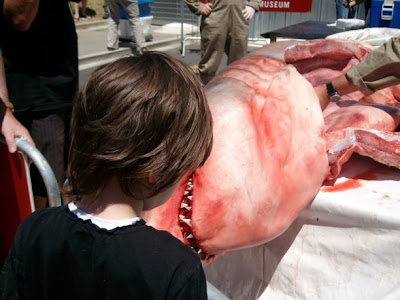
 We were nabbed by TV1 who interviewed Madeleine as to why we were there [to see the shark perhaps...] though Madeleine came up with something cleverer than that, and what Noah thought might be in the shark's stomach; Noah's answer of "a bicycle and maybe a can" left the reporter looking perplexed so the footage may get scrapped, nevertheless - Noah insists TV1's news tonight is compulsory viewing.
 You can watch